Best SQL Books for Beginners, Picked for MySQL Learners

The best SQL book for beginners depends on which database you plan to use. For MySQL, Learning SQL (3rd edition) and Head First SQL (2nd edition) are good starting points. If you prefer learning with real datasets in PostgreSQL, choose Practical SQL. For a book focused specifically on MySQL 8 development, go with MySQL Crash Course.
These recommendations broadly match the learning stages outlined in computingforgeeks' beginner SQL list.
We may earn a commission if you buy through links on this page. It never changes our verdicts. How we review.
Quick picks (all available on Amazon UK):
- Best first book (MySQL examples): Learning SQL, 3rd edition Check price on Amazon
- Best visual beginner (MySQL, 2nd ed 2026): Head First SQL, 2nd edition (check the edition and seller carefully, as the listing may show pre-order) Check price on Amazon
- Best for PostgreSQL storytelling: Practical SQL, 2nd edition Check price on Amazon
- Best MySQL 8 focused: MySQL Crash Course Check price on Amazon
- Best short sessions: Learn SQL in a Month of Lunches Check price on Amazon
- Best second book: SQL Antipatterns, Volume 1 Check price on Amazon
Learning SQL Server instead of MySQL? T-SQL Fundamentals (4th edition) is worth considering.
Which book, which database
| Book | Edition / year | Engine in exercises | Window functions | Level | Pair it with (same site) |
|---|---|---|---|---|---|
| Head First SQL (Fessel) | 2nd, 2026 | MySQL (per computingforgeeks) | See publisher TOC | Absolute beginner | /sqlhelp/joins_basic.shtml |
| Learning SQL (Beaulieu) | 3rd | MySQL examples | Yes (later chapters, publisher) | Beginner to intermediate | /sqlhelp/lists.shtml |
| Practical SQL (DeBarros) | 2nd, 2022 | PostgreSQL + pgAdmin | Covered in later chapters (publisher) | Beginner who likes real datasets | /sqlhelp/nullsvsemptystrings.shtml |
| MySQL Crash Course (Silva) | 1st, 2023 | MySQL 8 | Not stated in sources | Beginner focused on MySQL | /sqlhelp/lastinsertid.shtml |
| Learn SQL in a Month of Lunches | Manning | Mixed SQL (confirm in book) | Not stated in sources | Busy beginner, short sessions | /sqlhelp/ |
| SQL Antipatterns Vol. 1 (Karwin) | Vol. 1 | Mixed / conceptual | N/A (antipatterns) | Second book | /sqlhelp/sqlcalcfoundrows.shtml |
| T-SQL Fundamentals (Ben-Gan) | 4th | SQL Server T-SQL | Yes (SQL Server) | SQL Server beginners only | Skip unless on SQL Server |
The picks
Learning SQL, 3rd edition (Beaulieu)
Who it is for: beginners looking for a solid introduction to SQL with MySQL examples. computingforgeeks recommends it as a core text, while an independent review from simplifydatabase looks at its MySQL-based approach.
Who it is not for: anyone who prefers colourful illustrations and a more playful way of learning. Head First SQL may be a better fit.
Edition and engine: the 3rd edition is published by O'Reilly and uses MySQL examples throughout. On Amazon UK, it appears as "Learning SQL, 3e: Generate, Manipulate, and Retrieve Data". It was in stock on 5 November 2026. Available on Amazon UK.
Head First SQL, 2nd edition (Fessel)
Who it is for: complete beginners who find diagrams, puzzles and visual explanations easier to follow than traditional textbook chapters. computingforgeeks confirms that the 2nd edition uses MySQL exercises.
Who it is not for: readers looking for a concise reference book they can quickly consult while writing queries.
Edition warning: look for Fessel's 2026 2nd edition, not the much older 2007 1st edition. Amazon UK lists the newer version as "Head First SQL: A Learner's Guide to Querying and Managing Data".
The listing showed pre-order or marketplace fulfilment when checked. Make sure the edition and seller are correct before placing an order. Available on Amazon UK.
Practical SQL, 2nd edition (DeBarros)
Who it is for: beginners who like exploring real datasets rather than learning SQL through isolated examples. It teaches using PostgreSQL, so you need to be comfortable starting with that database.
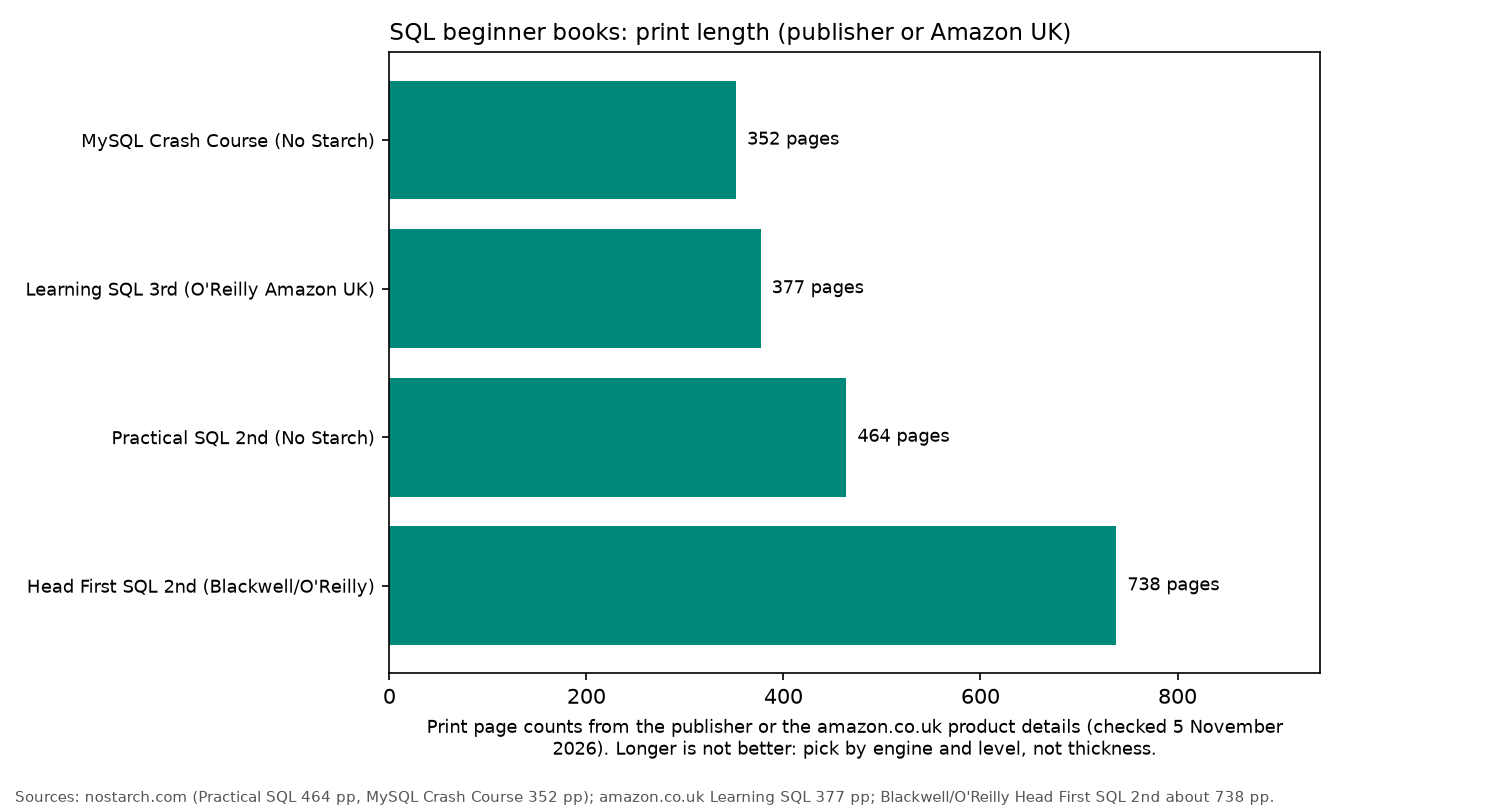
According to No Starch, the book has 464 pages, was published in January 2022 and uses PostgreSQL alongside pgAdmin. The concepts also apply to MySQL, Oracle and SQLite.
Who it is not for: SQL Server users. The publisher specifically notes that Microsoft's T-SQL is not covered.
Extras: the author's site includes information about setup chapters for Windows, macOS and Linux, along with a chapter on the command line.
Amazon UK stock appeared limited on 5 November 2026. Available on Amazon UK.
MySQL Crash Course (Silva)
Who it is for: beginners who already know they want to develop with MySQL 8.
No Starch lists the book at 352 pages, published in March 2023. Topics include installation, SELECT queries, data types, constraints and indexes. It also explains how to call MySQL from PHP, Python and Java.
Who it is not for: anyone looking for a database-independent introduction to SQL, particularly those planning to work with PostgreSQL.
Buying note: the Amazon UK listing showed pre-order or marketplace fulfilment when checked. Check who is selling the book before ordering. Available on Amazon UK.
Learn SQL in a Month of Lunches (Iannucci)
Who it is for: beginners with limited study time who would rather learn in manageable, regular sessions. Published by Manning, the book follows the publisher's short-session format.
Who it is not for: readers who need every exercise to work specifically with MySQL. The SQL engines used are mixed, so check the book before depending on it for MySQL projects.
Buying note: the Amazon UK listing showed pre-order or marketplace fulfilment when checked. Confirm the seller at checkout.
If you need a different explanation of a topic, the free SQL help pages make a useful companion. Available on Amazon UK.
SQL Antipatterns, Volume 1 (Karwin)
Who it is for: readers who have worked through a beginner book and can already write basic SQL queries. The focus here is on recognising and avoiding common mistakes in database design and queries.
computingforgeeks recommends it as a follow-up rather than a starting point.
Who it is not for: complete beginners who still need to learn the basics of writing queries.
Edition and stock: published by Pragmatic Bookshelf, Volume 1 is titled "SQL Antipatterns, Volume 1: Avoiding the Pitfalls of Database Programming".
Only a couple of copies were showing on Amazon UK on 5 November 2026. Available on Amazon UK.
T-SQL Fundamentals, 4th edition (Ben-Gan)
Who it is for: beginners learning SQL for a job or course that uses Microsoft SQL Server and its T-SQL dialect.
Who it is not for: MySQL learners. This book is written for SQL Server, making it the wrong starting point if your goal is MySQL.
Edition: the 4th edition is listed on Amazon UK as "T-SQL Fundamentals (Developer Reference)". It was in stock on 5 November 2026. Available on Amazon UK.
Book vs free tutorials
Books are useful because they teach SQL in a logical order. Short tutorials are better when you get stuck on one particular query or concept.
Using both makes sense. Work through your book, then turn to a focused tutorial when something needs a clearer explanation.
These pages cover common sticking points:
- Joins: basic SQL joins
- Lists: working with lists in SQL
- NULL vs empty: NULLs vs empty strings
- LAST_INSERT_ID: getting the last inserted ID
- SQL_CALC_FOUND_ROWS: counting rows for pagination
MySQL or PostgreSQL first?
Start with the database you actually need. If your job, course or web hosting uses MySQL, there is little reason to learn PostgreSQL first.
Learning SQL and Head First SQL both use MySQL examples, while MySQL Crash Course focuses specifically on MySQL 8.
If you have no particular database requirement and enjoy working with data, PostgreSQL is also a sensible choice. Practical SQL teaches through PostgreSQL, and No Starch confirms that its concepts carry over to MySQL. It does not cover T-SQL, though.
For more MySQL book suggestions, jobroadmaps maintains a separate list. There is also an r/mysql thread where readers share recommendations, although these are personal opinions rather than verified reviews.
FAQ
What is the best book to learn SQL from scratch?
For most people starting with MySQL, Learning SQL (3rd edition) is a dependable first choice. It offers a solid introduction without requiring you to switch database engines.
Head First SQL (2nd edition) is a good alternative if you prefer visual explanations. If learning with real datasets appeals more, Practical SQL teaches SQL through PostgreSQL.
computingforgeeks takes a similar approach to recommending these books for beginners.
Is Head First SQL still worth it (new 2026 edition)?
Yes, the 2026 2nd edition by Fessel is the version to consider. According to computingforgeeks, it includes MySQL exercises.
Be careful not to order the much older 2007 1st edition by mistake. Amazon UK's listing for the newer book may show pre-order or marketplace sellers, so double-check both the edition and seller before buying.
Should I learn MySQL or PostgreSQL first?
Choose the database you expect to use for work, study or your own projects.
If you have no specific requirement, MySQL is an approachable starting point, with books such as Learning SQL and MySQL Crash Course to guide you.
Practical SQL takes the PostgreSQL route. No Starch points out that its concepts also apply to MySQL, Oracle and SQLite. The core SQL skills you learn transfer well between MySQL and PostgreSQL.
Can you learn SQL from a book alone?
A book can teach you the concepts, but reading is only part of learning SQL. You also need to write and run the queries yourself.
Install a database and complete the exercises as you work through each chapter. When something does not make sense, try another explanation from a free resource such as the SQL help pages.
Combining a structured book with regular practice is a more reliable way to learn.
Which SQL book covers MySQL 8?
MySQL Crash Course by Silva focuses on MySQL 8.
No Starch says it covers installation, SELECT, data types, constraints, indexes and connecting to MySQL from PHP, Python and Java.
It is a suitable choice if you already know MySQL is the database you want to learn. For a broader introduction to SQL, another book may be more appropriate.
Do I need T-SQL Fundamentals if I use SQL Server?
If your job or course uses Microsoft SQL Server, T-SQL Fundamentals (4th edition) by Ben-Gan is worth considering. It teaches SQL Server's T-SQL dialect directly.
If you are learning MySQL, you can skip it.
Practical SQL is not an equivalent SQL Server option either. No Starch confirms that it does not cover T-SQL.
What should my second SQL book be?
Once you are comfortable writing basic queries, SQL Antipatterns, Volume 1 by Karwin is a good next choice.
Rather than starting again with SQL syntax, it explains common mistakes to avoid in database programming.
computingforgeeks also places it after the beginner stage, making it a natural follow-up to your first SQL book.
Ready to pick?
For a solid introduction built around MySQL examples, start with Learning SQL (3rd edition). If diagrams and visual exercises suit you better, choose Head First SQL (2nd edition).
Learning SQL, 3rd edition
Head First SQL, 2nd edition
As an Amazon Associate I earn from qualifying purchases.